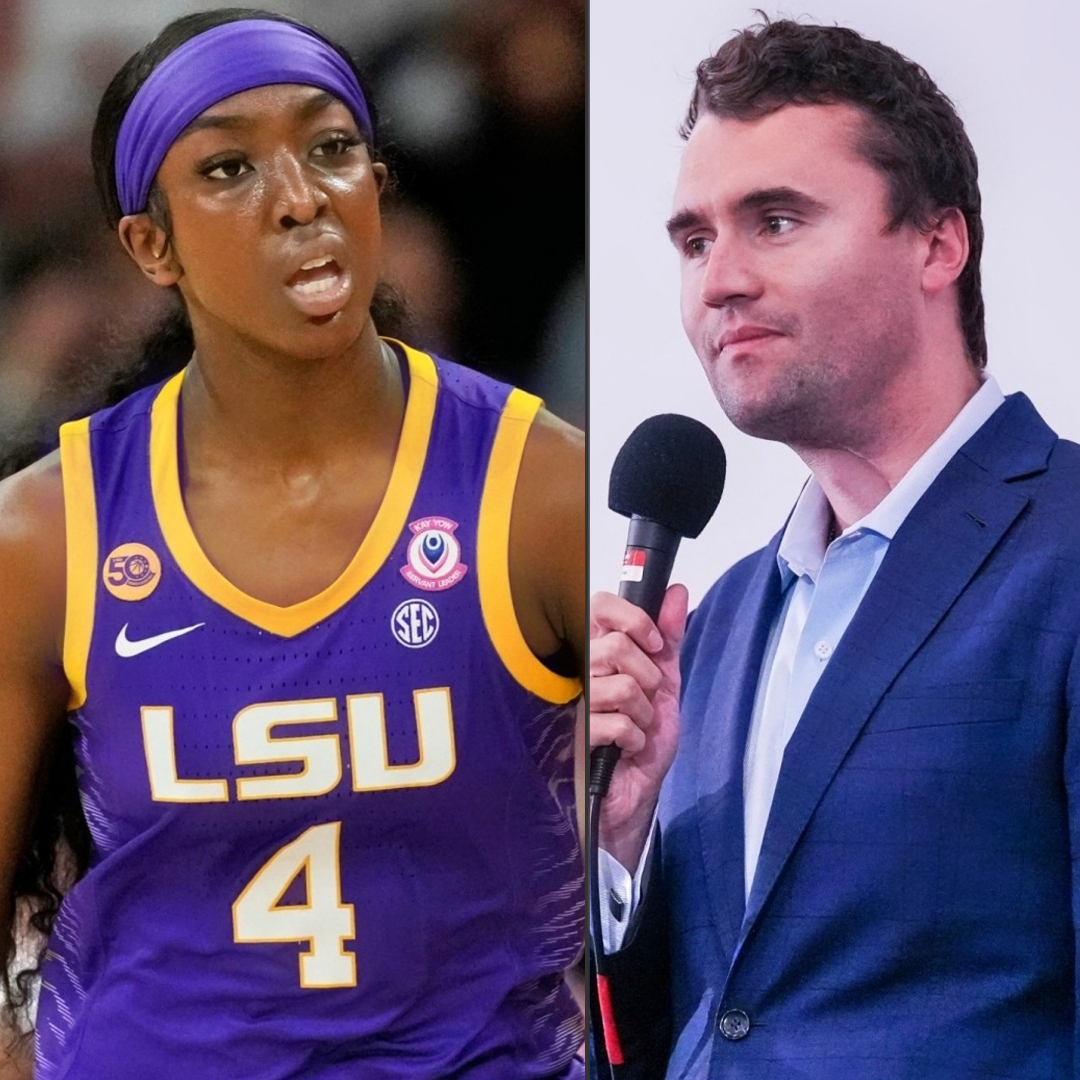
Most of those present expected the discussion to be polite, even sleepy. But one voice in the back row — steady, clear, and furious — would turn that assumption to ash.
Her name was Flau’jae Johnson.
Rising from her seat, the LSU basketball phenom and rapper — already a hometown hero with a national following — stepped toward the microphone. What she said next would send shockwaves across the country, ignite protests across the South, and thrust a 20-year-old student-athlete into the center of America’s newest cultural war.
“If You’re Going to Build a Monument…”
At first, no one seemed to notice her. Board members shuffled papers, photographers checked their cameras, and a few students whispered about weekend plans. Then, in a voice that carried the conviction of someone twice her age, Flau’jae began to speak.
“I’m proud of this university,” she said, eyes locked on the trustees, “but if you’re going to build a monument, build one for unity — not division.”
The room fell silent.
Charlie Kirk, the founder of Turning Point USA, had been a polarizing figure in Louisiana for years — celebrated by conservatives for his unapologetic defense of “American values,” and condemned by progressives for incendiary remarks about race, gender, and higher education. After his death, alumni donors had proposed the statue as a “tribute to courage.” But to many students, the idea felt less like a tribute and more like a test.
Flau’jae continued.
“This campus belongs to every student who walks these halls,” she said. “And every time we choose to honor someone who divided us more than they united us, we’re telling the next generation that money speaks louder than morals.”
One trustee shifted uncomfortably. Another whispered something to the university president. The tension in the room was thick enough to slice.
Then she leaned closer to the mic, and delivered the line that would explode across the internet by morning.
“You can’t preach unity with a statue built on division.”
Gasps. Applause. Shouts. Cameras rolling.
The moment had arrived — unscripted, electric, unstoppable.
A Viral Moment in Real Time
Within minutes, clips of Flau’jae’s speech flooded social media. By midnight, #FlaujaeSpeaks had surpassed one million mentions on X. By morning, the footage had aired on every major cable network.
“LSU STAR TAKES STAND,” read one chyron. “CAMPUS ERUPTS OVER CHARLIE KIRK STATUE,” read another.
To some, she was a hero — the voice of a new generation unwilling to be silenced by tradition. To others, she was a troublemaker — another athlete using fame to stoke outrage.
But what few realized that night was how personal her words were.
Because for Flau’jae Johnson, this wasn’t about politics. It was about memory.
The Weight of Legacy
Long before she wore LSU purple and gold, Flau’jae was known for something else entirely — her voice. The daughter of the late rapper Camoflauge, who was killed before she turned two, she grew up in Savannah, Georgia, raised by her mother and surrounded by the ghosts of dreams deferred. Music was her inheritance. Faith was her armor.
By fourteen, she’d competed on America’s Got Talent. By seventeen, she’d signed with Roc Nation. And by twenty, she was balancing Division I basketball, a rising music career, and a growing reputation as one of the most outspoken young women in college sports.
Her outspokenness wasn’t an act. It was survival.
“Every time I speak, I’m carrying people who were never allowed to,” she said once in an interview. “My daddy. My community. The kids who never made it out.”
So when she saw the proposal for the Kirk statue circulating among LSU’s alumni donors — complete with renderings and mock-ups showing it just steps away from Tiger Stadium — she felt a knot tighten in her chest.
“It wasn’t even about Charlie Kirk,” she later told a reporter. “It was about what it meant. What it said about who we choose to celebrate.”
The Statue That Broke the Internet
By the next morning, Baton Rouge was in full meltdown mode.
Outside the LSU Administration Building, students gathered in clusters, holding handmade signs: “Our Campus, Our Voice.” “Education, Not Idolatry.” “No Statue for Hate.”
Across the street, a smaller group of Kirk supporters countered with banners that read “Free Speech Forever” and “Honor American Values.”
By noon, local police had closed the street. National news vans lined the curb. What had begun as a simple campus proposal had turned into a microcosm of America’s widening divide — a fight over symbols, legacy, and who gets to define patriotism.
Meanwhile, in a small coffee shop near campus, Flau’jae sat with her coach, Kim Mulkey, scrolling through her phone as notifications poured in faster than she could read them.
“Baby, you just shook the whole country,” Mulkey reportedly told her.
Flau’jae laughed, exhausted. “I didn’t mean to shake it,” she said. “I just meant to tell the truth.”
The Donor Fallout
Behind the scenes, the reaction was even more explosive.
Three major donors threatened to withdraw funding unless LSU moved forward with the Kirk statue. Others, including several prominent Black alumni, issued an open letter praising Johnson’s courage and calling for a “reassessment of what kind of legacy LSU wants to build.”
University officials, blindsided by the backlash, released a carefully worded statement: “LSU values diversity of thought and open dialogue. The proposal for a new statue remains under review.”
Translation: they had no idea what to do next.
Even the governor weighed in, calling for “respectful discussion” while quietly advising the university to “avoid unnecessary political theater.” But by then, the theater had already gone global.
The Comment Heard ‘Round the World
Two nights later, Flau’jae appeared on ESPN’s Outside the Lines — reluctantly, at first. She wore a white LSU hoodie, no makeup, no bravado, just calm conviction.
“I’m not against anyone,” she told the host. “I’m just saying our symbols should bring us together. We’ve spent too long fighting over statues. Maybe it’s time we build something that reflects who we’re becoming, not who we were.”
Her words struck a chord. Former athletes, musicians, and civil rights leaders chimed in with support. Even some conservative commentators admitted — cautiously — that she had handled herself with “remarkable poise.”
But not everyone was impressed.
Within hours, online trolls flooded her pages with insults, fake quotes, and edited clips. Anonymous accounts accused her of “disrespecting free speech.” Political operatives weaponized her image in fundraising emails. It was the price of being young, female, and unapologetically outspoken in an era that punishes all three.
“I Knew the Fire Would Come”
Flau’jae didn’t back down.
“I knew the fire would come,” she said in a later interview with The Atlantic. “But you can’t be afraid of burning if you’re trying to light something up.”
Her coach shielded her from the worst of the noise. Teammates surrounded her with support. On social media, her followers doubled. Brands that had once been cautious about “political athletes” suddenly wanted to partner with her.
But behind the scenes, LSU’s administration was struggling to contain the fallout. Emails later obtained by The Advocate revealed frantic exchanges between university officials and donors. “We underestimated the reaction,” one wrote. “This has become a national flashpoint.”
And in the middle of that firestorm stood a 20-year-old student who never asked for one.
The Night at Tiger Stadium
Three weeks later, LSU hosted its homecoming game. The stadium was a wall of sound — 90,000 fans drenched in gold and adrenaline. When Flau’jae stepped onto the court at halftime, the applause was deafening.
She didn’t mention statues. She didn’t mention politics.
She simply picked up a microphone and began to rap.
It was a new verse — one she hadn’t shared publicly before.
“They build their monuments from fear and stone,
But truth don’t need a pedestal, it stands on its own.
You can silence my mic, but not my tone,
‘Cause every seed they buried, I’ve made my home.”
The crowd erupted. Students chanted her name. Even the board members, watching from their VIP box, stood frozen. It was the kind of moment that reminds a university what its soul looks like.
Beyond the Bronze
By December, the Board quietly announced that the statue proposal had been “postponed indefinitely.”
In official terms, that meant it was dead.
In emotional terms, it meant something else entirely.
LSU had become a mirror for a country still at war with itself — torn between nostalgia and progress, reverence and reinvention. And at the center of that reflection stood a young woman who had dared to ask a simple question: Who are we building this for?
Flau’jae’s words didn’t just stop a statue. They started a conversation.
A New Kind of Leadership
When asked months later if she’d do anything differently, Flau’jae smiled.
“I’d probably wear a better outfit,” she joked, then turned serious. “But no — I said what I needed to say. Not for me, but for the people coming after me. If my little sister walks across this campus and sees that statue, what does she learn about us? What do we teach her about what we value?”
Her answer landed like a quiet thunderclap.
It’s easy to mistake outrage for courage. It’s harder to recognize that sometimes, courage looks like a calm young woman standing at a microphone, saying what everyone else is too afraid to say.
That’s what happened in Baton Rouge that night. Not a rebellion. Not a scandal. Just truth — spoken loudly enough to echo beyond the campus walls.
Epilogue: The Monument We Build
Today, there’s no bronze statue at LSU’s main quad. The space once reserved for Charlie Kirk’s likeness now sits empty — a patch of open grass between the flagpole and the library steps. Students walk past it every day, often without realizing its history.
But every so often, someone stops to look. They remember the night a 20-year-old athlete stood up and said no. They remember how the whole country watched.
And they remember that sometimes, the most powerful monuments aren’t made of stone. They’re made of conviction.